Добрый день, Коллеги. Важное сообщение, просьба принять участие. Музей Ферсмана ищет помощь для реставрационных работ в помещении. Подробности по ссылке
Estimating mineral resources from drill hole data is an activity that is fraught with difficulty. Most classical statisticians would regard the data for any ore reserve estimate as dangerously inadequate. This would often apply even in cases where the geologist felt that the deposit had been "overdrilled". <...>
The discipline which is now known as geostatistics began to develope over thirty years ago for mining evaluation and since has extended to other fields of activity. Around 1960 in particular, G. Matheron built linear geostatistics. Some of its tools (variogram, kriging) are widely used nowadays. Linear geostatistics makes it possible for instance to evaluate the metal content of a mining block or panel by estimating the mean of the grades of the points in it from samples. The reader of this book is supposed to be familiar with linear geostatistics. <...>
This introductory chapter presents a discrete approach specially designed for modeling the geometry and the properties of natural objects such as those encountered in biology and geology.
С каждым годом в мире становится все меньше неразведанных участков и месторождений нефти и газа, и в таких условиях для увеличения добычи или ее поддержания нефтяные компании переходят к разработке объектов в сложных геологических условиях. К ним относятся и нетрадиционные коллекторы: сланцевые нефть и газ, нефтематеринские толщи, содержащие уже созревшие углеводороды (УВ), но еще не мигрировавшие, низкопроницаемые плотные породы. Эти залежи не контролируются структурными, стратиграфическими, литологическими и прочими традиционными факторами. [47] Кроме того, к сложным геологическим условиям, безусловно, относятся и тектонически экранированные ловушки, и залежи в глубоководных акваториях, и многие другие.
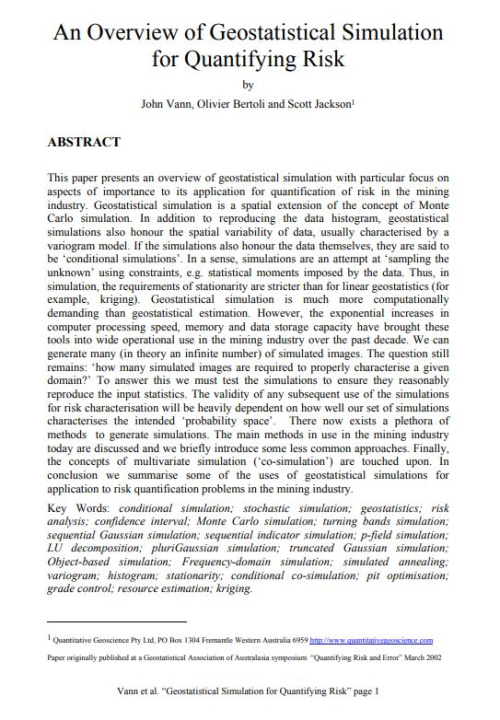
This paper presents an overview of geostatistical simulation with particular focus on aspects of importance to its application for quantification of risk in the mining industry. Geostatistical simulation is a spatial extension of the concept of Monte Carlo simulation. In addition to reproducing the data histogram, geostatistical simulations also honour the spatial variability of data, usually characterised by a variogram model. If the simulations also honour the data themselves, they are said to be ‘conditional simulations’.
Compositional data arise naturally in several branches of science, including geology. In geochemistry, for example, these constrained data seem to occur typically, when one normalizes raw data or when one obtains the output from a constrained estimation procedure, such as parts per one, percentages, ppm, ppb, molar concentRations, etc.
GSLIB is the name of a directory containing the geostatistical software developed at Stanford. Generations of graduate students have contributed to
this constantly changing collection of programs, ideas, and utilities. Some of the :nost widely used public-domain geostatistical software [58, 62, 721 and many more in-house programs were initiated from GSLIB. It was decided to open the GSLIB directory to a wide audience, providing the source code to seed new developments, custom-made application tools, and, it is hoped, new theoretical advances <...>
This book is aimed at postgraduates, undergraduates and workers in industry who require an introduction to geostatistics. It is based on seven years of courses to undergraduates, M.Sc. students and short courses to industry, and reflects the problems which have been encountered in presenting this material to mining engineers and geologists over a wide age range, and with an equally wide range of numerical ability. The book would provide the foundation of a course of about 20 to 30 hours, or of a five-day short course.
Earth sciences data are typically distributed in space and/or in time. Knowledge of an attribute value, say, a mineral grade or a pollutant concentration, is thus of little interest unless location and/or time of measurement are known and accounted for in the data analysis. Geostatistics provides a set of statistical tools for incorporating the spatial and temporal coordinates of observations in data processing.